
One of the biggest challenges facing modern Security Operations Centers (SOCs) is understanding whether their detection capabilities are keeping pace with today's threat landscape. Many organizations invest heavily in SIEM platforms, EDR solutions, threat intelligence, and detection engineering, yet they struggle to answer a fundamental question:
"How much of the attacker lifecycle can we actually detect?"
A SOC may have thousands of detection rules, but without a structured method to measure coverage, it's impossible to know whether those rules effectively detect adversary behaviors or simply generate noise.
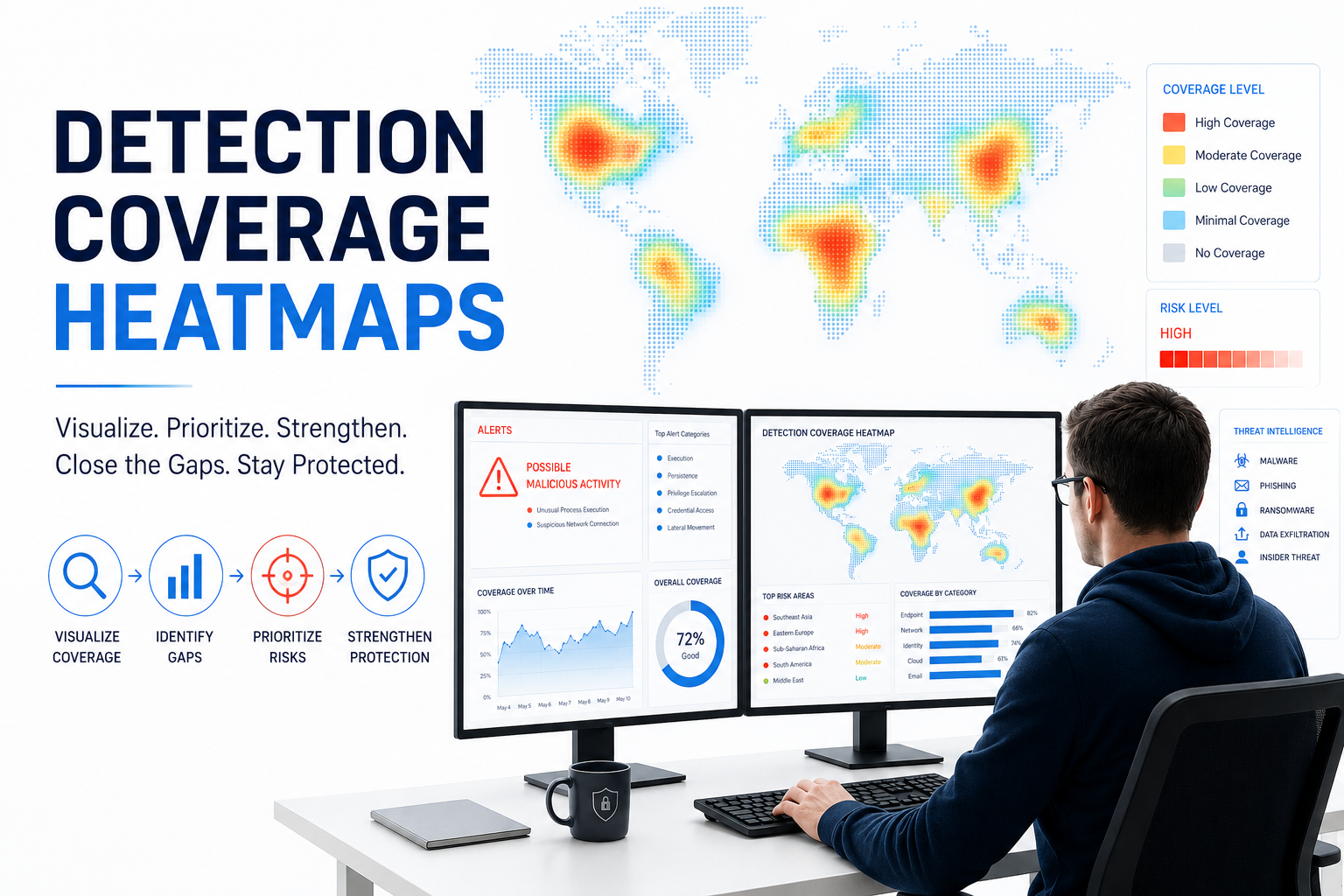
Detection coverage heatmaps provide a data-driven answer. By mapping detection content to the MITRE ATT&CK framework, security teams can visualize their strengths, identify detection gaps, prioritize engineering efforts, and continuously improve their defensive posture.
This article explores how to design, build, and operationalize detection coverage heatmaps as part of a mature detection engineering program.
Why Detection Coverage Matters
Security leaders often measure SOC performance using metrics such as:
- Number of alerts generated
- Number of detection rules
- Mean Time to Detect (MTTD)
- Mean Time to Respond (MTTR)
While these metrics are valuable, they don't answer a more strategic question:
Can our SOC detect the techniques attackers are most likely to use against us?
Attackers don't think in terms of SIEM rules, they think in terms of objectives:
- Gain initial access
- Escalate privileges
- Steal credentials
- Move laterally
- Establish persistence
- Exfiltrate sensitive data
Detection coverage heatmaps shift the focus from operational volume to adversary behavior, enabling organizations to measure security effectiveness rather than simply monitoring activity.
What Is a Detection Coverage Heatmap?
A detection coverage heatmap is a visual representation of how well an organization's detection capabilities map to ATT&CK tactics and techniques.
Instead of listing individual SIEM rules, the heatmap shows:
- Which ATT&CK techniques are monitored
- Which techniques have high-confidence detections
- Which techniques have partial visibility
- Which techniques are completely uncovered
A simplified example might look like this:
|
ATT&CK Technique |
Coverage |
Confidence |
|
PowerShell (T1059.001) |
Full |
High |
|
Credential Dumping (T1003) |
Partial |
Medium |
|
Remote Services (T1021) |
None |
Low |
|
WMI (T1047) |
Full |
High |
|
Valid Accounts (T1078) |
Partial |
Medium |
When visualized with color coding (green, yellow, and red), these tables become powerful dashboards for both technical teams and executive leadership.
Why Use the MITRE ATT&CK Framework?
The ATT&CK framework provides a standardized taxonomy of adversary behaviors observed in real-world cyberattacks.
Rather than focusing on malware families or indicators of compromise (IOCs), ATT&CK categorizes attacker actions into:
- Tactics (the attacker's objective)
- Techniques (how the objective is achieved)
- Sub-techniques (specific implementations)
For example:
|
Tactic |
Technique |
|
Execution |
PowerShell |
|
Credential Access |
OS Credential Dumping |
|
Persistence |
Scheduled Task |
|
Discovery |
Account Discovery |
|
Lateral Movement |
Remote Services |
|
Exfiltration |
Exfiltration Over Web Services |
Using ATT&CK as the foundation for a heatmap ensures that detection coverage aligns with real adversary behavior rather than individual technologies.
Step 1: Inventory Existing Detection Content
Before building a heatmap, organizations need a comprehensive inventory of their detection assets.
Typical sources include:
- SIEM correlation rules
- EDR/XDR analytics
- Sigma rules
- IDS/IPS signatures
- UEBA detections
- Cloud-native detection rules
- Custom detection scripts
- Threat intelligence-based alerts
For each detection, capture metadata such as:
|
Field |
Description |
|
Rule Name |
Detection title |
|
ATT&CK Technique |
Technique ID |
|
ATT&CK Tactic |
Associated tactic |
|
Data Source |
Sysmon, EDR, Azure AD, etc. |
|
Severity |
Alert priority |
|
Rule Owner |
Detection engineer |
|
Validation Date |
Last successful test |
|
Detection Confidence |
High, Medium, Low |
This inventory serves as the foundation for your heatmap.
Step 2: Map Every Detection to ATT&CK
Every detection rule should map to one or more ATT&CK techniques.
Examples include:
|
Detection Rule |
ATT&CK Technique |
|
Encoded PowerShell |
T1059.001 |
|
LSASS Memory Access |
T1003 |
|
Scheduled Task Creation |
T1053 |
|
WMI Execution |
T1047 |
|
PsExec Detection |
T1021 |
Rules that cannot be mapped should be reviewed to ensure they contribute meaningful detection value.
Many SIEM content packs and Sigma rules already include ATT&CK mappings, making this process easier.
Step 3: Evaluate Detection Quality
Coverage is not binary. A detection may exist but be unreliable, noisy, or untested.
A maturity scoring model helps distinguish between basic and high-confidence detections.
Example scoring:
|
Score |
Description |
|
0 |
No detection |
|
1 |
Signature or IOC-based detection |
|
2 |
Behavioral detection |
|
3 |
Correlated multi-source detection |
|
4 |
Validated high-fidelity detection |
This scoring model allows the heatmap to represent both coverage and detection quality.
Step 4: Assess Telemetry Readiness
Detection quality depends on telemetry quality.
A rule cannot detect an attack if the necessary logs are unavailable.
Evaluate key data sources such as:
- Windows Security Events
- Sysmon
- EDR telemetry
- DNS logs
- Firewall logs
- Cloud audit logs
- Identity provider logs
- Network flow data
Missing telemetry often explains detection gaps more than missing rules.
Step 5: Build the Heatmap
With detections mapped and scored, create a matrix that displays ATT&CK tactics along one axis and techniques along the other.
Use a simple color scheme:
|
Color |
Meaning |
|
🟢 |
High-confidence detection |
|
🟡 |
Partial or moderate coverage |
|
🔴 |
No detection |
|
⚪ |
Not applicable |
This visual representation quickly highlights strengths and weaknesses.
For example:
|
Technique |
Status |
|
PowerShell |
🟢 |
|
Credential Dumping |
🟡 |
|
Pass-the-Hash |
🔴 |
|
Registry Persistence |
🟡 |
|
WMI Execution |
🟢 |
The heatmap becomes an actionable roadmap for detection engineering.
Step 6: Validate Detection Coverage
A mapped detection rule is only valuable if it reliably detects the intended behavior.
Validation methods include:
- Purple team exercises
- Adversary emulation
- Atomic Red Team tests
- Red team engagements
- Breach and attack simulation platforms
Validation should verify:
- Alert generation
- Telemetry collection
- Rule accuracy
- Workflow effectiveness
- Analyst response procedures
Without testing, detection coverage may exist only on paper.
Step 7: Prioritize Detection Engineering
Not every ATT&CK technique requires equal attention.
Organizations should prioritize based on:
- Threat intelligence
- Industry-specific attacks
- Critical business assets
- Cloud adoption
- Identity infrastructure
- Ransomware trends
For example, a financial institution may prioritize credential access and lateral movement, while a healthcare provider may focus on ransomware-related techniques.
Risk-based prioritization ensures that engineering resources are invested where they provide the greatest value.
Metrics That Matter
Detection coverage heatmaps become even more valuable when paired with operational metrics.
Track:
- ATT&CK technique coverage percentage
- High-confidence detection percentage
- Detection validation rate
- False positive rate
- Mean Time to Detect (MTTD)
- Mean Time to Respond (MTTR)
- Detection engineering backlog
- Detection tuning frequency
These metrics help SOC leaders measure progress and communicate effectiveness to executives.
Common Challenges
Organizations often encounter several obstacles when implementing detection coverage heatmaps:
- Incomplete or inconsistent telemetry
- Detection rules that lack ATT&CK mappings
- High false positive rates
- Outdated detection content
- Lack of ownership for rule maintenance
- Limited validation processes
Addressing these issues requires ongoing collaboration between detection engineers, threat hunters, incident responders, and red teams.
Best Practices
To maximize the value of detection coverage heatmaps:
- Align detections to ATT&CK techniques from the outset.
- Focus on behavioral detections instead of static indicators.
- Continuously validate detections through adversary emulation.
- Update mappings as ATT&CK evolves.
- Prioritize high-risk techniques based on your organization's threat profile.
- Review and tune detection rules regularly to maintain fidelity.
- Present heatmaps to both technical teams and executive stakeholders to support informed decision-making.
The Future of Detection Coverage
As organizations embrace AI-assisted detection engineering, cloud-native security, and Detection-as-Code practices, detection coverage heatmaps will become increasingly dynamic.
Future capabilities may include:
- Automated ATT&CK mapping using AI
- Real-time coverage scoring
- Continuous validation pipelines
- Predictive gap analysis
- Integration with threat intelligence platforms
- Executive dashboards that correlate coverage with organizational risk
These advancements will help SOCs move from reactive monitoring to proactive, threat-informed defense.
Conclusion
Detection coverage heatmaps provide one of the clearest measures of a SOC's defensive capability. Rather than counting alerts or detection rules, they reveal how effectively an organization can identify the techniques used by real-world adversaries.
By inventorying detection content, mapping it to the ATT&CK framework, assessing detection quality, validating through adversary emulation, and continuously refining coverage, organizations can build a mature detection engineering program that is both measurable and resilient.
In today's threat landscape, success is not defined by the number of security tools deployed or alerts generated. It is defined by an organization's ability to detect, understand, and respond to adversary behavior. Detection coverage heatmaps provide the visibility needed to achieve that goal and should be a cornerstone of every modern Security Operations Center.
Phelix Oluoch
Founder, PhelixCyber
W: PhelixCyber.com
